

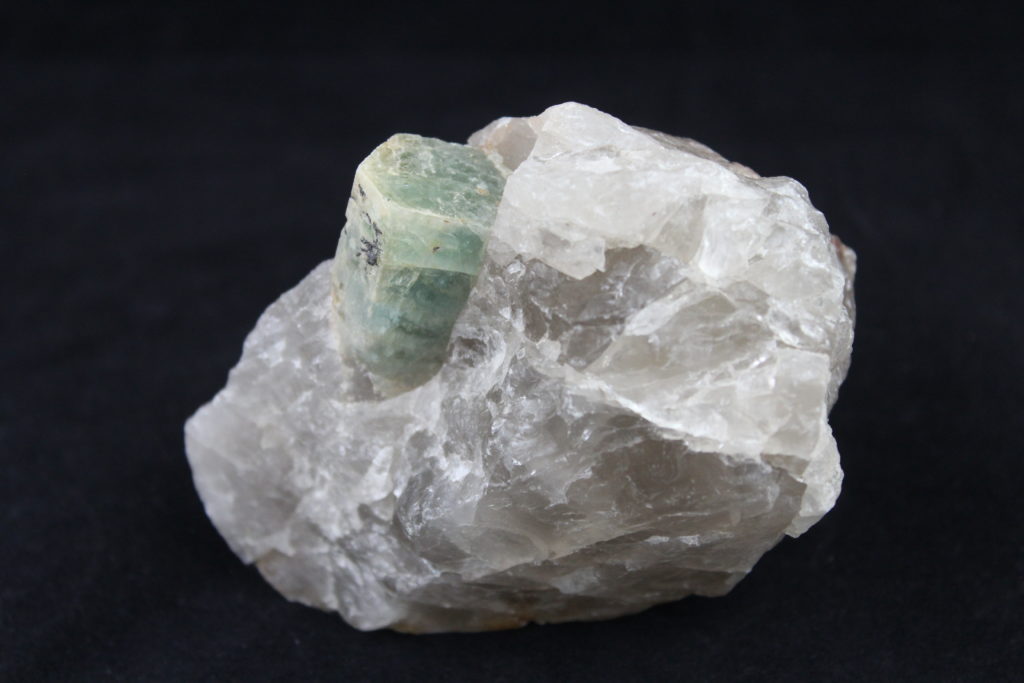
Aquamarine in Quartz #6
$ 63.00
Aquamarine in Quartz #6 BERYL (var. AQUAMARINE) HISTORY, NAME, LOCALITIES: Aquamarine, which has been known since antiquity, was recognized as a variety of beryl in 1797. The name “aquamarine,” pronounced ahh-kwa-mar-REEN, stems from the Latin aqua marina, literally meaning “sea water,” in allusion to its blue and greenish-blue colors. Important collecting localities are in Namibia, Brazil, Pakistan, Afghanistan, Sri Lanka, Russia, Madagascar, Malawi, and the United States (Colorado, Maine, California). Aquamarine crystallizes in the hexagonal system as well-developed, six-sided, transparent-to-translucent prisms. It has a blue-to-greenish-blue color, a vitreous luster, a Mohs hardness of 7.5-8.0, and a specific gravity of 2.6-2.9. It occurs primarily in granite pegmatites in association with such minerals as albite, quartz, and muscovite. According to modern metaphysical practitioners, aquamarine provides foresight and courage; enhances happiness, intelligence, and youthful qualities; and alleviates anxiety-related stress. Aquamarine has no technological uses. Aquamarine is valued by collectors because it is an uncommon variety of beryl, and also for its pleasing blue colors, well-developed crystals, and occurrence in attractive composite specimens with other pegmatite minerals. QUARTZ (var. ROCK CRYSTAL) HISTORY, NAME, LOCALITIES: Rock crystal, which is common and occurs worldwide, has been collected since prehistory. Notable collecting localities are found in India, Brazil, Germany, Peru, Bolivia, Namibia, Russia, and the United States (Arkansas, Colorado, Maine, Connecticut, Virginia). MINERALOGY, PROPERTIES, OCCURRENCE: Rock crystal is the transparent, colorless variety of macrocrystalline quartz [silicon dioxide, SiO2). The word “quartz” is believed to have originated with the Slavic kwardy, meaning “hard,” in allusion to its substantial hardness. It crystallizes in the hexagonal system and occurs mainly in hydrothermal veins, granite pegmatites, and as geode linings as short-to-long, horizontally striated, hexagonal, prismatic crystals with pyramidal terminations and distinctive, water-clear transparency. It has a Mohs hardness of 7.0, a conchoidal fracture, vitreous luster, and specific gravity of 2.65. METAPHYSICAL PROPERTIES, LORE, USES: Rock crystal has since antiquity been one of the most widely collected of all minerals. It has served as a gemstone and ornamental stone in many cultures. Until quartz was synthesized in the 1960s, rock crystal was vital to electronic frequency controls, filters, and timing devices. Modern metaphysical practitioners call rock crystal the “universal crystal” because of its numerous abilities to sharpen insight, enhance spiritual development, improve concentration, refine focus, and energize the mind. COLLECTORS’ INFORMATION: Rock crystal is widely collected for its brilliant transparency, superb hexagonal crystal development, and frequent occurrence on large plates and in geodes to make interesting display pieces. SKU: Aquamarine in Quartz #6 Tag: Brazil.
More like this
Front Facing Paved Hinge Ring w/ Center CZ
$ 25.16
Fabric : Cotton
Style : Saree
Washcare : Hand Wash Only. Iron on reverse.
Do not bleach & expose to excessive heat and sunlight for long.
Blouse : Comes with a running blouse